Classic space adventures gave generations of readers their first picture of the solar system: red deserts crossed by colonists, rocket pilots dodging boulders in a crowded asteroid belt, and mysterious moons hiding alien life. Some of those pictures have aged badly. Others turn out to be closer to the truth than their authors could have known.
This guide is for science fiction writers (teens and adults), and for teachers who use space stories to spark interest in science. It looks at three favorite settings, Mars, the asteroid belt and Jupiter’s moon Europa, and compares the classic image with what NASA missions have found. The point is not to forbid anything. Fiction is allowed to bend the rules. But a writer who knows the real science can bend it on purpose, and often finds that the facts are stranger and more useful than the clichés.
Mars: the planet everyone wants to fix
The classic image
In much older science fiction, Mars is a planet that can be made into a second Earth. Colonists warm it up, thicken its air, melt its ice and eventually walk around without spacesuits. The process, called terraforming, might take centuries in the story, but it works.
What we know now
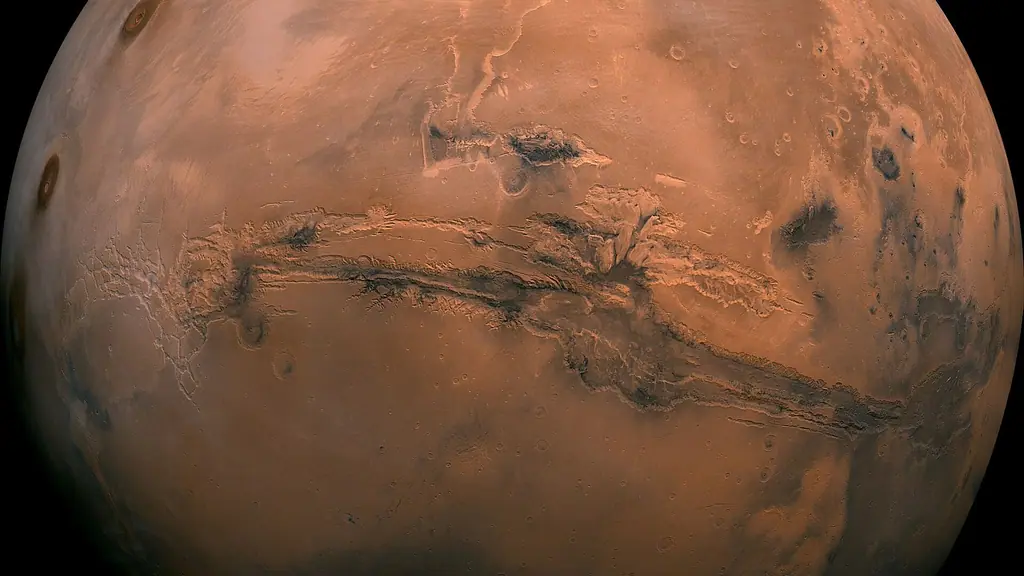
Mars is cold, dry and wrapped in a very thin atmosphere made mostly of carbon dioxide, nitrogen and argon. NASA puts its surface pressure at about 0.6 percent of Earth’s. Temperatures can reach about 20°C (70°F) at the warmest and drop to around −153°C (−225°F). There is water ice just under the surface in the polar regions, and a Martian day is a little longer than ours (24.6 hours), while a year lasts 687 Earth days.
In 2018, a study funded by NASA and led by Bruce Jakosky of the University of Colorado Boulder, with Christopher Edwards of Northern Arizona University, asked the big terraforming question directly: is there enough carbon dioxide on Mars to warm it if we released it? Their answer, published in Nature Astronomy, was no, at least not with present-day technology. Vaporizing the polar ice caps would only raise the pressure to about 1.2 percent of Earth’s. Much of the remaining carbon dioxide is locked in soil or minerals where it cannot easily be released, and most of Mars’s ancient atmosphere was stripped away to space long ago by the solar wind and solar radiation, a process the MAVEN spacecraft has measured. Mars also has no global magnetic field today to shield an atmosphere.
How writers can use it
- Make terraforming a struggle, not a montage. If your story includes terraforming, it needs technology we don’t have, such as importing gases from elsewhere. That gap is a story engine: who pays, who benefits, who objects?
- Use the real dangers. Thin air, cold, dust, radiation and a long communication delay with Earth are dramatic without inventing anything.
- Let colonists live underground or under domes. It is more realistic, and it creates tight, tense spaces for character drama.
Key idea
The best science fiction often comes from taking a real limit seriously, then asking what people would do about it.
The asteroid belt: mostly empty space
The classic image
Films and stories love a crowded asteroid field: a pilot weaving between tumbling rocks only meters apart, collisions on every side.
What we know now
Most asteroids orbit the Sun between Mars and Jupiter, in the main belt. NASA estimates that the belt contains between 1.1 and 1.9 million asteroids larger than 1 kilometer across, plus millions of smaller ones. That sounds crowded until you consider the space involved. The total mass of all the asteroids combined is less than that of Earth’s Moon. Vesta, the largest asteroid, is about 530 kilometers across.
During NASA’s Dawn mission, which orbited Vesta and then the dwarf planet Ceres, the mission team estimated the spacing between asteroids. Assuming roughly 2 million asteroids at least a mile wide spread evenly through the belt, the average distance between them would be about 1.9 million miles (around 3 million kilometers), nearly eight times the distance from Earth to the Moon. The team noted that real asteroids are not spread evenly, but the conclusion holds: the belt is mostly empty space. The mission team described the chance of a spacecraft like Dawn hitting an asteroid as small (though not zero), and planners simply avoided regions where the risk might be higher than usual.
How writers can use it
- Replace the dodging scene with isolation. A mining crew in the belt might be days or weeks from the nearest neighbor. Loneliness, supply problems and rescue delays are richer sources of tension than flying rocks.
- Make each asteroid a place. Asteroids range from tiny boulders to bodies hundreds of kilometers across, with different compositions. That variety supports a whole map of distinct settings.
- If you want a debris field, give it a cause. A recent collision, a mining accident or a deliberate attack can produce a dangerous cloud of fragments, and the cause becomes part of the plot.
Try this
Rewrite a classic “asteroid chase” scene so that the danger comes from distance instead of crowding: the nearest help is 40 hours away, and something on the ship has just failed. What does your pilot do first?
Europa: the ocean under the ice
The classic image
Older space adventures often imagined Jupiter’s moons as frozen, lifeless rocks, or as worlds with breathable surfaces and native creatures waiting to be met.
What we know now
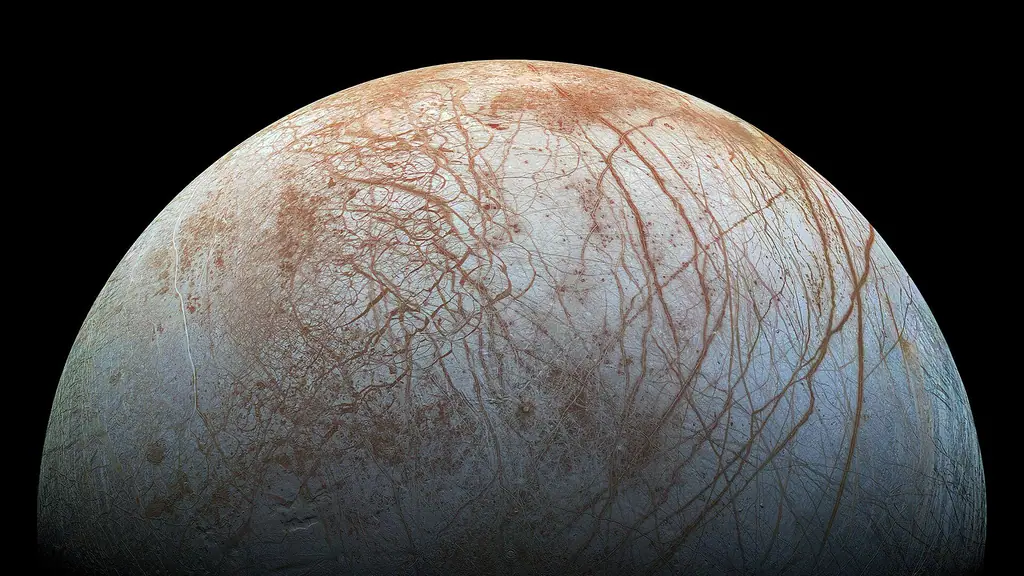
Europa is slightly smaller than Earth’s Moon (about 90 percent of its size), and its surface is a shell of ice that scientists estimate at 15 to 25 kilometers thick. Underneath, evidence points to a global, salty ocean estimated at 60 to 150 kilometers deep, which may hold about twice as much water as all of Earth’s oceans combined.
The strongest evidence came from NASA’s Galileo spacecraft, which detected a disturbance in Jupiter’s magnetic field near Europa that is best explained by a conductive fluid, most likely salty water, beneath the ice. Later observations suggested that thin plumes of water vapor may sometimes rise from the surface. The surface itself is harsh: Jupiter’s radiation blasts it, which would be harmful to life there, although that same radiation may help create chemicals that could act as fuel for life in the ocean below.
NASA’s Europa Clipper spacecraft launched on October 14, 2024, and is scheduled to reach Jupiter in April 2030. It is planned to make 49 close flybys of Europa. Its goal is not to find life directly, but to determine whether Europa currently has conditions that could support it.
How writers can use it
- Put the story under the ice. A research station drilling through kilometers of ice, a submarine exploring a dark ocean, or a crew waiting out a radiation storm are all grounded in real conditions.
- Use uncertainty. We don’t yet know if Europa is habitable. That open question gives fiction room to speculate honestly, as long as the story doesn’t pretend the answer is already settled.
- Respect the scale. A shell of ice many kilometers thick is a serious obstacle. Getting through it is an adventure in itself.
A quick comparison
| Setting | Classic image | Current science | Story opportunity |
|---|---|---|---|
| Mars | A second Earth after terraforming | Very thin CO₂ atmosphere; not enough accessible CO₂ to terraform with present-day technology | Domes, underground cities, political fights over an impossible project |
| Asteroid belt | Rocks packed close together | Average spacing of millions of kilometers; total mass less than the Moon | Isolation, distance, rescue delays, distinct small worlds |
| Europa | Frozen dead rock or alien jungle | Ice shell over a deep salty ocean; habitability under study | Drilling, submarines, radiation, honest uncertainty |
Keeping science fiction honest without losing the fun
You don’t need a physics degree to write good science fiction. You do need a few habits:
- Check one fact per scene. NASA’s planet and mission pages are written for the public and kept up to date.
- Decide what you will invent. Pick one or two impossible technologies (faster travel, better shielding) and keep everything else realistic. Readers accept a big leap more easily when the small details are right.
- Let numbers create drama. Travel times, temperatures and distances are plot material.
- Date your setting. If your story is set two centuries from now, think about what might have changed, and what probably hasn’t.
In the classroom
Grades 6–12: Give small groups one of the three settings and a NASA fact page. Each group lists three facts, then writes a one-paragraph story scene that depends on at least two of them. Groups swap scenes and check each other’s science.
Ready to build your own world? Our guide on how to write science fiction covers the craft side, and science fiction story ideas offers premises rooted in real science. For a sense of the tradition these settings come from, see classic space-adventure series books. The sci-fi world generator can hand you a planet to start from, and the space adventure title generator will name the book when you finish.
Sources
- Mars Terraforming Not Possible Using Present-Day TechnologyNASA
- Mars: FactsNASA Science
- Asteroids: FactsNASA Science
- Dawn: Frequently Asked QuestionsNASA Science
- Europa: FactsNASA Science
- Europa ClipperNASA Science